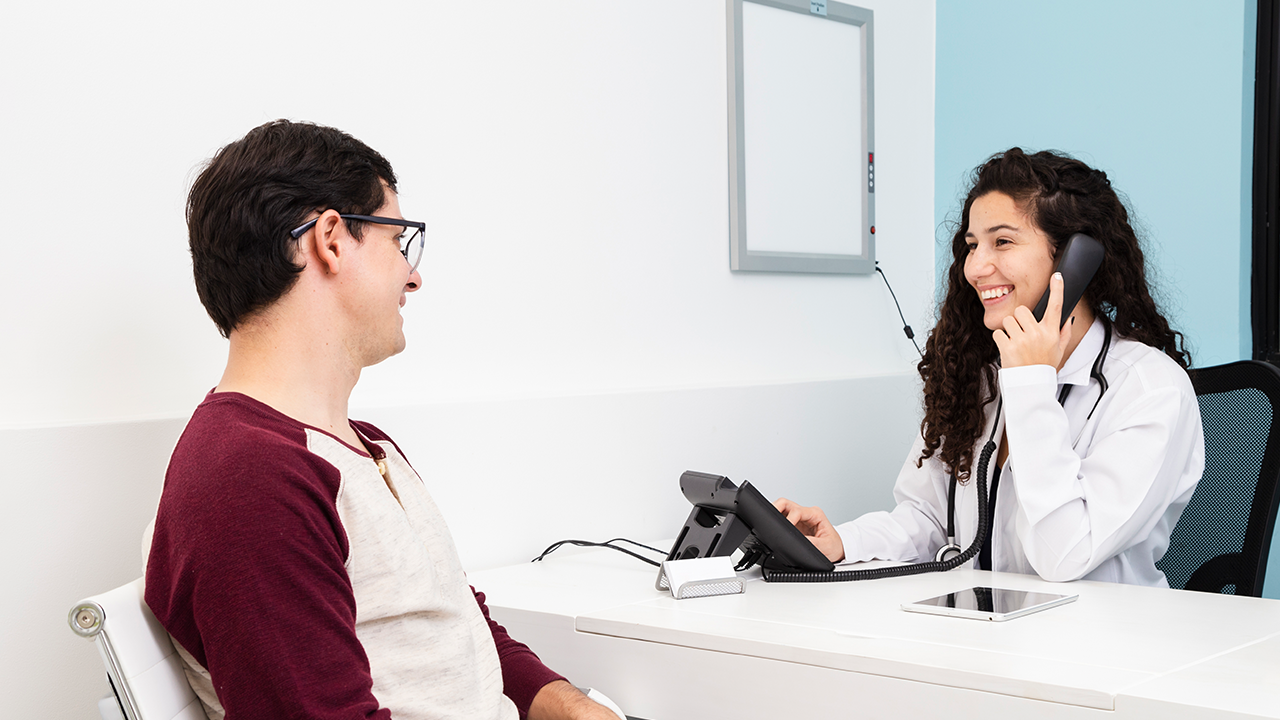
get older. It can make conversations,\r\ntelevision, phone calls, and speech in noisy environments more difficult. The\r\ncondition is commonly called presbycusis and often affects both ears.\r\nEarly evaluation can help identify the type and severity of hearing loss and\r\ndetermine appropriate management options.
What Is Age-Related Hearing Loss?
\r\n\r\nAge-related hearing loss, or\r\npresbycusis, is hearing loss that develops gradually with aging. It commonly\r\naffects both ears and may make high-pitched sounds and speech harder to hear,\r\nparticularly in noisy environments. Age-related changes in the inner ear and\r\nauditory pathways, along with lifetime noise exposure and other factors, can\r\ncontribute to the condition.
Presbycusis is one of the most common\r\nhearing problems among older adults. Because it usually develops slowly, a\r\nperson may not immediately recognize that their hearing has changed.
Some people first notice that others\r\nappear to be mumbling or that conversations are difficult to follow when\r\nseveral people are talking.
Age-Related Hearing Loss Symptoms
\r\n\r\nThe early symptoms of age-related\r\nhearing loss often include difficulty understanding speech, frequently asking\r\npeople to repeat themselves, increasing the TV volume, and struggling to hear\r\nin noisy places. Symptoms may develop gradually, so family members sometimes\r\nnotice the problem before the person experiencing the hearing loss does.
Common age related hearing loss symptoms\r\ninclude:
● \r\nDifficulty understanding\r\nconversations, especially with background noise
● \r\nFrequently asking others to repeat\r\nthemselves
● \r\nThinking people are speaking\r\nunclearly or mumbling
● \r\nTurning the television or phone\r\nvolume higher than usual
● \r\nDifficulty following group\r\nconversations
● \r\nTrouble understanding speech over\r\nthe telephone
● \r\nDifficulty hearing higher-pitched\r\nvoices
● \r\nAvoiding social situations because\r\nconversations are difficult
● \r\nRinging or other sounds in the\r\nears, sometimes called tinnitus
These symptoms do not necessarily mean\r\nthat aging is the only cause. Earwax blockage, medication effects, noise\r\nexposure, medical conditions, and other ear problems can also affect hearing. A\r\nprofessional evaluation can help determine the cause.
Age-Related Hearing Loss Causes and Risk Factors
\r\n\r\nAge related hearing loss causes are\r\nusually multifactorial rather than being caused by aging alone. Changes in the\r\ninner ear and auditory nerve pathways are important contributors. Lifetime\r\nexposure to loud noise, genetics, certain medical conditions, and some\r\nmedications that can damage the inner ear may also increase the risk.
Factors associated with hearing loss in\r\nolder adults include:
● \r\nNatural changes in the inner ear\r\nassociated with aging
● \r\nLong-term exposure to loud sounds
● \r\nGenetic or biological\r\nsusceptibility
● \r\nCertain medical conditions,\r\nincluding diabetes and high blood pressure
● \r\nSome medications that can affect\r\nthe sensory structures of the ear
● \r\nPrevious ear problems or other\r\ncauses of hearing impairment
ASHA describes hearing loss in older\r\nadults as the result of a complex combination of aging, environmental exposure,\r\ngenetic and biological factors, and medical conditions.
What Types of Hearing Loss Can Occur With Aging?
\r\n\r\nAge-related hearing loss is generally\r\nassociated with sensorineural changes involving the inner ear and auditory\r\npathways. However, older adults can also develop conductive or mixed hearing\r\nloss from other conditions. Because different types of hearing loss require\r\ndifferent approaches, hearing testing is important before choosing treatment.
Sensorineural Hearing Loss
\r\n\r\nThis occurs when structures in the inner\r\near or the auditory nerve pathways do not function normally. Presbycusis\r\ncommonly falls into this category.
Conductive Hearing Loss
\r\n\r\nThis occurs when sound cannot travel\r\nefficiently through the outer or middle ear. Earwax blockage, fluid, or certain\r\nmiddle-ear problems can contribute.
Mixed Hearing Loss
\r\n\r\nMixed hearing loss involves both\r\nsensorineural and conductive components.
A hearing evaluation can help determine\r\nwhether the hearing difficulty is related to age-related changes or another\r\ntreatable ear condition.
How Is Age-Related Hearing Loss Diagnosed?
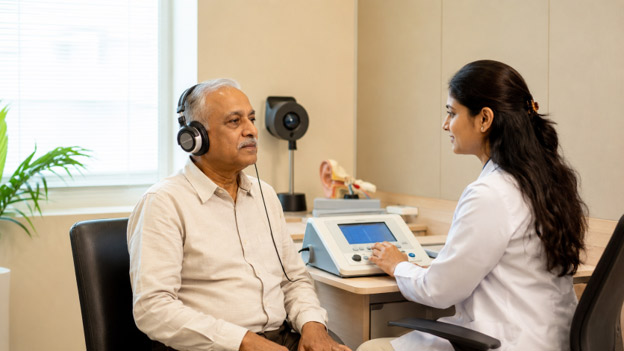
\r\n\r\nAge-related hearing loss is diagnosed\r\nthrough a combination of medical history, ear examination, and hearing testing.\r\nAn audiologist can measure hearing sensitivity, determine the degree and type\r\nof hearing loss, and help identify appropriate management options. Additional\r\nmedical assessment may be recommended when symptoms suggest another ear or\r\nhealth condition.
A hearing evaluation may include:
● \r\nDiscussion of hearing concerns and\r\nmedical history
● \r\nExamination of the ears
● \r\nPure-tone hearing testing
● \r\nSpeech testing
● \r\nOther tests when clinically\r\nappropriate
The goal is not simply to determine\r\nwhether someone can hear a sound. Testing helps establish how well a person\r\nhears different frequencies and understands speech.
Hearing Healthcare Clinics describes its\r\nhearing evaluation as an audiological assessment used to identify the presence,\r\ndegree, and possible causes of hearing loss and to guide treatment options.
Hearing Tests for Seniors
\r\n\r\nA hearing test for seniors can help\r\nidentify hearing loss that may otherwise go unnoticed. Audiological testing can\r\ndetermine the severity and type of hearing loss and provide information that\r\nhelps an audiologist recommend appropriate hearing solutions, communication\r\nstrategies, or further medical evaluation when necessary.
Older adults may benefit from evaluation\r\nwhen they:
● \r\nFrequently misunderstand\r\nconversations
● \r\nHave difficulty hearing on the\r\nphone
● \r\nNeed unusually high TV volume
● \r\nStruggle in restaurants or family\r\ngatherings
● \r\nNotice ringing in the ears
● \r\nFeel that hearing is affecting\r\ncommunication or daily activities
If hearing changes occur suddenly,\r\nparticularly in one ear, urgent medical assessment is important because sudden\r\nhearing loss can require prompt treatment.
Age-Related Hearing Loss Treatment Options
\r\n\r\nAge related hearing loss treatment\r\ndepends on the type and severity of hearing loss and the person\'s communication\r\nneeds. Management may include hearing aids, assistive listening devices,\r\ncommunication strategies, and treatment of an underlying ear condition when one\r\nis present. Severe hearing loss may require evaluation for cochlear\r\nimplantation.
Common management options include:
Hearing Aids
\r\n\r\nHearing aids are electronic devices that\r\namplify and process sounds according to an individual\'s hearing needs. Modern\r\ndevices may include features such as directional microphones, noise-management\r\ntechnology, rechargeable batteries, and wireless connectivity.
A hearing professional can help select,\r\nfit, and adjust hearing aids according to hearing test results and lifestyle\r\nneeds.
Assistive Listening Devices
\r\n\r\nThese can include specialized telephone\r\nsystems, smartphone-based tools, TV listening systems, alerting devices, and\r\nother technologies designed to make communication easier.
Cochlear Implants
\r\n\r\nFor some people with severe or profound\r\nhearing loss who receive limited benefit from hearing aids, a cochlear implant\r\nevaluation may be appropriate. Cochlear implants are surgically implanted\r\ndevices and are different from hearing aids.
Hearing Aids for Seniors: Do They Help?
\r\n\r\nHearing aids for seniors can improve\r\naccess to speech and everyday sounds for people whose hearing loss is\r\nappropriate for amplification. They do not restore normal hearing or cure the\r\nunderlying hearing loss, but properly selected and fitted devices can support\r\ncommunication and daily activities.
The most suitable hearing aid depends on\r\nfactors such as:
● \r\nDegree and pattern of hearing loss
● \r\nLifestyle and communication\r\nenvironments
● \r\nManual dexterity
● \r\nTechnology preferences
● \r\nComfort and fit
● \r\nBudget
● \r\nNeed for smartphone or other\r\ndevice connectivity
Hearing aids should be selected based on\r\nindividual hearing needs rather than simply choosing the most expensive device.
Lifestyle and Communication Tips
\r\n\r\nPeople with hearing loss can make\r\ncommunication easier by reducing background noise, facing the person speaking,\r\nusing visual cues, and asking others to speak clearly without shouting. Family\r\nmembers and caregivers can also make conversations easier by choosing quieter\r\nenvironments and confirming important information.
Helpful strategies include:
● \r\nFace the person while speaking
● \r\nReduce background television or\r\nmusic
● \r\nChoose quieter areas for\r\nconversations
● \r\nAsk people to speak clearly and at\r\na comfortable pace
● \r\nAsk for important information to\r\nbe repeated or written down
● \r\nUse captions when watching\r\ntelevision
● \r\nTell family members about specific\r\nlistening difficulties
These simple changes can make\r\ncommunication more comfortable while a person is being evaluated or fitted with\r\nhearing technology.
Can Age-Related Hearing Loss Be Prevented?
\r\n\r\nThere is currently no guaranteed way\r\nto prevent all age-related hearing loss because aging, genetics, and biological\r\nfactors play important roles. However, protecting hearing from excessive noise\r\ncan reduce the risk of noise-related damage. Regular hearing evaluations can\r\nalso help identify changes early.
Practical hearing-protection measures\r\ninclude:
● \r\nKeep personal audio at a\r\nreasonable volume
● \r\nLimit prolonged exposure to loud\r\nsounds
● \r\nUse appropriate hearing protection\r\nin noisy environments
● \r\nMove away from very loud sound\r\nsources when possible
● \r\nFollow professional advice when\r\ntaking medications that may affect hearing
NIDCD notes that researchers do not yet\r\nknow how to prevent age-related hearing loss completely, but protecting the\r\nears from damaging noise can help prevent noise-induced hearing loss.
When Should Someone See an Audiologist?
\r\n\r\nYou should consider seeing an\r\naudiologist when hearing difficulties interfere with conversations, phone\r\ncalls, television, work, social activities, or daily communication. An\r\naudiologist can perform a comprehensive hearing evaluation and explain whether hearing\r\naids, other hearing technology, communication strategies, or medical referral\r\nmay be appropriate.
Do not assume that difficulty hearing is\r\nsimply a normal part of getting older. Hearing changes deserve proper\r\nevaluation because some causes may be treatable.
Seek prompt medical attention for sudden\r\nhearing loss, especially when hearing decreases rapidly or unexpectedly.
Age-Related Hearing Loss: Myths vs Facts
| Myth | Fact |
| Hearing loss is always\r\nan unavoidable part of aging. | Aging increases risk,\r\nbut hearing loss can have multiple causes and should be evaluated. |
| Hearing aids cure\r\nhearing loss. | Hearing aids help\r\nimprove access to sound but do not cure the underlying condition. |
| If I can hear loud\r\nsounds, my hearing is normal. | Hearing aids help\r\nimprove access to sound but do not cure the underlying condition. |
| Hearing loss only\r\naffects older people. | Hearing loss can occur\r\nat any age. |
| You only need a hearing\r\ntest when hearing becomes very poor. | Hearing loss can occur\r\nat any age. |
Key Takeaways
\r\n\r\n
Age-related hearing loss, or\r\npresbycusis, usually develops gradually and can affect both ears. Common signs\r\ninclude difficulty understanding speech, especially in background noise, asking\r\nfor repetition, and increasing the TV volume. A professional hearing evaluation\r\ncan identify the type and degree of hearing loss and guide appropriate\r\ntreatment.
The most important points are:
● \r\nPresbycusis is the medical term\r\ncommonly used for age-related hearing loss.
● \r\nSymptoms often develop gradually.
● \r\nAging is only one factor; noise\r\nexposure, genetics, medical conditions, and certain medications can also\r\ncontribute.
● \r\nA hearing evaluation is important\r\nbefore selecting hearing solutions.
● \r\nHearing aids can help suitable\r\npatients but do not cure hearing loss.
● \r\nCommunication strategies and\r\nassistive devices can complement hearing technology.
● \r\nSudden hearing loss requires\r\nprompt medical assessment.
Frequently Asked Questions
\r\n\r\n1. What is age-related hearing loss called?
\r\n\r\nAge-related hearing loss is commonly\r\ncalled presbycusis. It usually develops gradually as people age and\r\ncommonly affects both ears.
2. What are the first signs of age-related hearing loss?
\r\n\r\nEarly signs can include difficulty\r\nunderstanding speech in noisy places, asking people to repeat themselves,\r\nturning up the TV, and feeling that people are mumbling.
3. What causes age-related hearing loss?
\r\n\r\nAge-related hearing loss can involve\r\nchanges in the inner ear and auditory pathways. Noise exposure, genetics,\r\ncertain medical conditions, and some medications can also contribute.
4. Can age-related hearing loss be treated?
\r\n\r\nYes. While age-related sensorineural\r\nhearing loss generally cannot simply be reversed, it can often be managed with\r\nhearing aids, assistive devices, communication strategies, and other\r\nappropriate interventions.
5. Can hearing aids restore normal hearing?
\r\n\r\nNo. Hearing aids do not restore normal\r\nhearing or cure hearing loss. They are designed to improve access to sound and\r\nsupport communication.
6. How often should seniors get a hearing test?
\r\n\r\nThe appropriate testing schedule depends\r\non individual risk and symptoms. Anyone noticing hearing difficulties should\r\ndiscuss testing with a healthcare professional or audiologist rather than\r\nwaiting for hearing loss to become severe.
7. Is age-related hearing loss usually in both ears?
\r\n\r\nPresbycusis commonly affects both ears.\r\nHearing loss that is sudden, significantly different between the ears, or\r\nassociated with other concerning symptoms should be medically evaluated.
8. Is hearing loss in seniors a normal part of aging?
\r\n\r\nHearing loss becomes more common with\r\nage, but significant hearing difficulty should not simply be dismissed as\r\nnormal aging. Evaluation can identify the type and severity of hearing loss and\r\npossible contributing factors.
9. Can loud noise make age-related hearing loss worse?
\r\n\r\nLong-term exposure to loud noise can\r\ndamage hearing and contribute to hearing loss. Protecting your ears from\r\nexcessive noise is an important part of hearing health.
10. What is the best treatment for hearing loss in older\r\nadults?
\r\n\r\nThere is no single best treatment for\r\neveryone. The appropriate option depends on the type and severity of hearing\r\nloss, communication needs, lifestyle, and medical factors.
\r\n\r\n
Professional Hearing Evaluation
\r\n\r\nIf you or an older family member is\r\nhaving difficulty hearing conversations, understanding speech in noisy\r\nenvironments, or frequently asking others to repeat themselves, consider\r\nscheduling a professional hearing evaluation.
Hearing Healthcare Clinics provides\r\naudiological hearing evaluations and personalized hearing solutions. The clinic\r\nhas locations across Rajasthan, including Jaipur, Jodhpur, Udaipur, Ajmer,\r\nAlwar, Bikaner, Bhilwara, Sikar, and Sri Ganganagar.
A professional evaluation can help you\r\nunderstand your hearing needs and explore appropriate options such as hearing\r\naids or other hearing-care solutions.
Book a hearing evaluation today and\r\ntake the first step toward clearer communication and better hearing confidence.